
PRODUCT DESIGN & UX
Interfaces people actually want to use.
Research-led product design, design systems and UI/UX — built in lockstep with engineering.
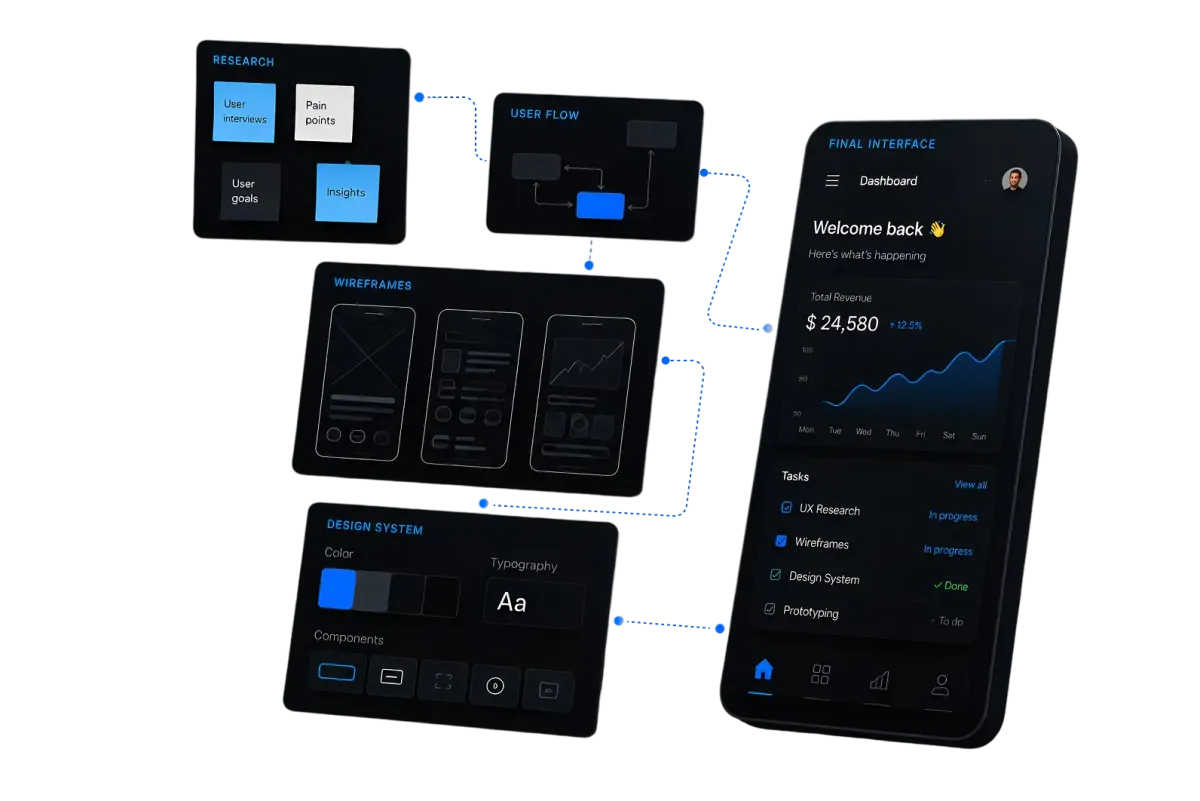
We design products research-first: interfaces, flows, and design systems shaped by how people actually use software, not by guesswork. Design happens alongside engineering here rather than thrown over a wall, so what gets designed is what gets built. Accessibility and WCAG conformance are part of the work from the start, because a product only works if everyone who needs it can use it.
How we design
- Research
Research-led design
We start with the people who’ll use the thing — interviews, flows and testing — so the interface solves the real problem.
- Product design
Interfaces that get used
Clean, fast, accessible product UI for web and mobile — designed alongside the engineers who’ll build it.
- Systems
Design systems
Reusable component libraries and tokens that keep a product consistent as it grows across teams and surfaces.
- Inclusive
Accessibility (WCAG)
WCAG 2.1 AA built in from the start — colour contrast, keyboard navigation, screen-reader support and clear focus states, tested with assistive technology rather than assumed.
Practice
- User research
- Wireframing
- Prototyping
- Design systems
- Accessibility (WCAG)
- Usability testing
Design work
MUTTS Canine Cantina
A responsive membership and reservation website that lets MUTTS guests buy passes and book dog-park visits online, cutting the venue's admin load.
View case study →WeWomen
A women-only marketplace app where women entrepreneurs list businesses and sell to a targeted community, with zero commission on transactions.
View case study →Chromavid
A mobile app that brings real-time green-screen chroma key to everyday users, letting anyone shoot studio-style photo and video composites on a phone.
View case study →Edu Books
A cross-platform learning app for children aged 4 to 8 that teaches through interactive games, animations and parent-managed controls.
View case study →E-commerce Storefronts
A run of custom storefronts across Shopify, WooCommerce and BigCommerce — from meal-subscription plans to build-your-own ordering — each tuned for conversion and run at scale.
View case study →FAQ
Product design & UX — common questions
Why design and build together instead of separately?
When design and engineering work in separate phases, designs often specify things that are expensive or impossible to build, and the final product drifts from the mockups. We keep designers and engineers in the same conversation so feasibility is checked early and handoff is not a translation exercise. The result is a product that ships closer to what was designed, with less rework.
Do you do user research, or just visual design?
We do both, and the research drives the design. Depending on the stage and budget, that ranges from user interviews and usability testing to reviewing analytics and support tickets for patterns. Research keeps decisions grounded in real behaviour rather than internal opinion, which is where a lot of design effort is otherwise wasted.
When do we need a design system?
A design system pays off once a product has enough screens and contributors that consistency starts to slip and teams rebuild the same components repeatedly. For a small single-screen product it is overhead; for a growing platform it saves time and prevents drift. We can start with a lightweight set of components and tokens and expand it as the product and team grow.
How do you handle accessibility and WCAG conformance?
We build toward WCAG 2.1 AA as a baseline, covering colour contrast, keyboard navigation, screen reader support, and clear focus states. Accessibility is designed in from the start rather than retrofitted, because retrofitting is far more expensive and tends to miss things. We test with assistive technology and automated checks so conformance is verified, not assumed.
Explore other services