
Mobile
Native vs Cross-Platform vs Flutter: Choosing a Mobile Stack in 2026
Picking a mobile stack is one of the few early decisions that’s expensive to reverse. A wrong call doesn’t show up in week two — it shows up in month nine, when you’re fighting the framework instead of shipping features. The good news is that in 2026 there are only three serious contenders, and the choice between them is mostly mechanical once you’re honest about your constraints.
The Three Realistic Options
Native means Swift with SwiftUI on iOS and Kotlin with Jetpack Compose on Android. Two codebases, two languages, full access to everything Apple and Google ship — usually on day one.
React Native gives you one TypeScript codebase that renders real native UI components, with a JavaScript engine driving the logic. Its New Architecture (the Fabric renderer and the JSI bridge replacement) is now the default and has been stable in production for a while.
Flutter also gives you one codebase, written in Dart, but it takes a different bet: it paints every pixel itself through its own rendering engine rather than mounting platform widgets. That single decision explains most of Flutter’s strengths and most of its trade-offs.
There’s no fourth option worth your time. Web wrappers and hybrid WebView shells still exist, but for anything that wants to feel like an app rather than a website in a box, they’re a false economy.
The Dimensions That Actually Decide It
Forget benchmarks that measure a spinning cube. The dimensions below are the ones that show up in real budgets and real retention numbers.
Performance and startup. Native is the ceiling — nothing beats code compiled straight to the platform with no runtime in between. Flutter is genuinely close for most apps because it compiles Dart to native ARM and controls its own render pipeline; startup is heavier than native but rarely a dealbreaker. React Native’s New Architecture closed most of the old gap by removing the asynchronous bridge, but a JavaScript engine is still in the loop, so heavy computation or very high-frequency UI updates can still surface jank if you’re careless.
UI fidelity and platform feel. This is where the philosophies split. React Native renders actual platform controls, so a date picker looks like an iOS date picker because it is one — you inherit platform behaviour for free, including the parts you forgot about. Flutter draws its own widgets, which gives you pixel-perfect consistency across both platforms but means you’re responsible for matching native conventions, and you adopt new OS design languages when Flutter ships support, not when Apple or Google does. Native always feels native because it is.
Development speed and cost. One codebase is roughly one team instead of two. For a standard CRUD-and-screens app, React Native and Flutter both cut time-to-market and ongoing cost substantially versus native. Native’s cost is real: you’re staffing and coordinating two parallel implementations of the same product.
Team and hiring. React Native runs on TypeScript, so anyone from your web team is halfway home, and the hiring pool is enormous. Flutter’s Dart talent pool is smaller but has matured a lot, and Dart is easy to pick up. Native requires two distinct specialisations; strong Swift and Kotlin engineers are in demand and priced accordingly.
Access to native APIs and SDKs. Native wins by definition — new iOS and Android capabilities are available the moment the OS ships. Both cross-platform frameworks reach native APIs through plugins; the common stuff is well covered, but a brand-new sensor, a niche Bluetooth profile, or a vendor SDK that only ships iOS and Android libraries may need you to write a native module yourself. Budget for that bridge work if your app lives close to the hardware.
Graphics, animation, and games. Flutter’s owned rendering engine makes it the strongest of the cross-platform two for rich custom animation and bespoke visual design. React Native handles standard motion fine and offloads heavy work to native. But for serious 3D, AR, or game-grade rendering, none of these is the right tool — that’s native plus Metal/Vulkan, or a dedicated game engine.
Long-term maintenance and risk. Native carries the least framework risk — Apple and Google aren’t going anywhere — at the cost of maintaining two codebases forever. React Native’s risk profile improved with the New Architecture, and a large open ecosystem plus Meta’s continued use de-risks it. Flutter is technically mature, but its governance sits with a single sponsor, and that concentration is a fair question to weigh for a product you expect to run for a decade.
The Comparison at a Glance
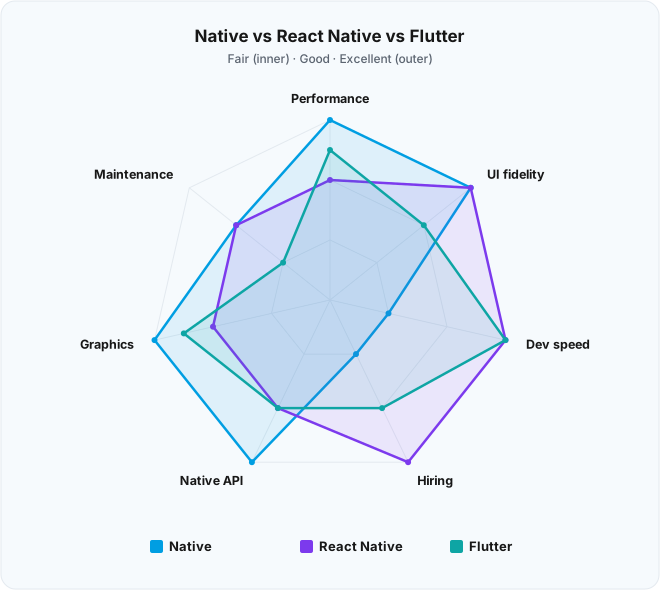
| Dimension | Native | React Native | Flutter |
|---|---|---|---|
| Performance & startup | Excellent | Good | Very good |
| UI fidelity / platform feel | Excellent | Excellent | Good |
| Dev speed & cost | Fair | Excellent | Excellent |
| Hiring & team | Fair (two skill sets) | Excellent | Good |
| Native API access | Excellent | Good | Good |
| Graphics & animation | Excellent | Good | Very good |
| Maintenance & risk | Good | Good | Fair |
2026 Context
A few things have settled since the framework wars of the early 2020s. React Native’s New Architecture is no longer a migration anxiety — it’s the baseline, and the synchronous rendering path means the performance arguments people used to make against it are mostly dated. Flutter has reached real maturity as an engineering product; the open questions are organisational rather than technical, around how investment and governance hold up under a single corporate sponsor. And native hasn’t been displaced where it always mattered: heavy graphics and AR, deep platform integration, and performance-critical paths where every millisecond and every megabyte of memory counts.
The honest summary is that cross-platform got good enough that “native by default” is no longer the safe answer for most apps — but “cross-platform always” was never true either.
The Decision
Choose Native when your app is performance-critical or hardware-close — AR, heavy real-time graphics, computer vision, audio processing — or when you need new OS features the day they ship, or deep integration with platform capabilities like widgets, watch apps, and background processing. Also choose it when you genuinely have the budget and team to run two codebases well and the product justifies that investment.
Choose React Native when you have web or TypeScript strength on the team, you want genuine native UI components and platform behaviour for free, and your app is the common shape: content, commerce, social, dashboards, transactional flows. It’s the pragmatic default for teams that already live in the JavaScript ecosystem and want the largest hiring pool.
Choose Flutter when you want one codebase with pixel-identical UI across platforms, your design is custom and animation-heavy rather than strictly platform-conventional, and you value a single consistent toolchain. It’s a strong fit for brand-led products where visual control matters more than inheriting every native UI affordance.
If you’re still torn between the two cross-platform options, the tiebreaker is usually your existing team: a JavaScript shop leans React Native, a greenfield team that wants design control leans Flutter.
There’s no universally correct answer here — only the right answer for your product, your team, and your timeline. If you’d like a straight read on which of these fits what you’re building, take a look at our mobile development work and start a project with us. We’ll tell you honestly which stack we’d reach for, and why.