
Applied AI
AI in Production vs AI Demos: What It Actually Takes to Ship AI That Works
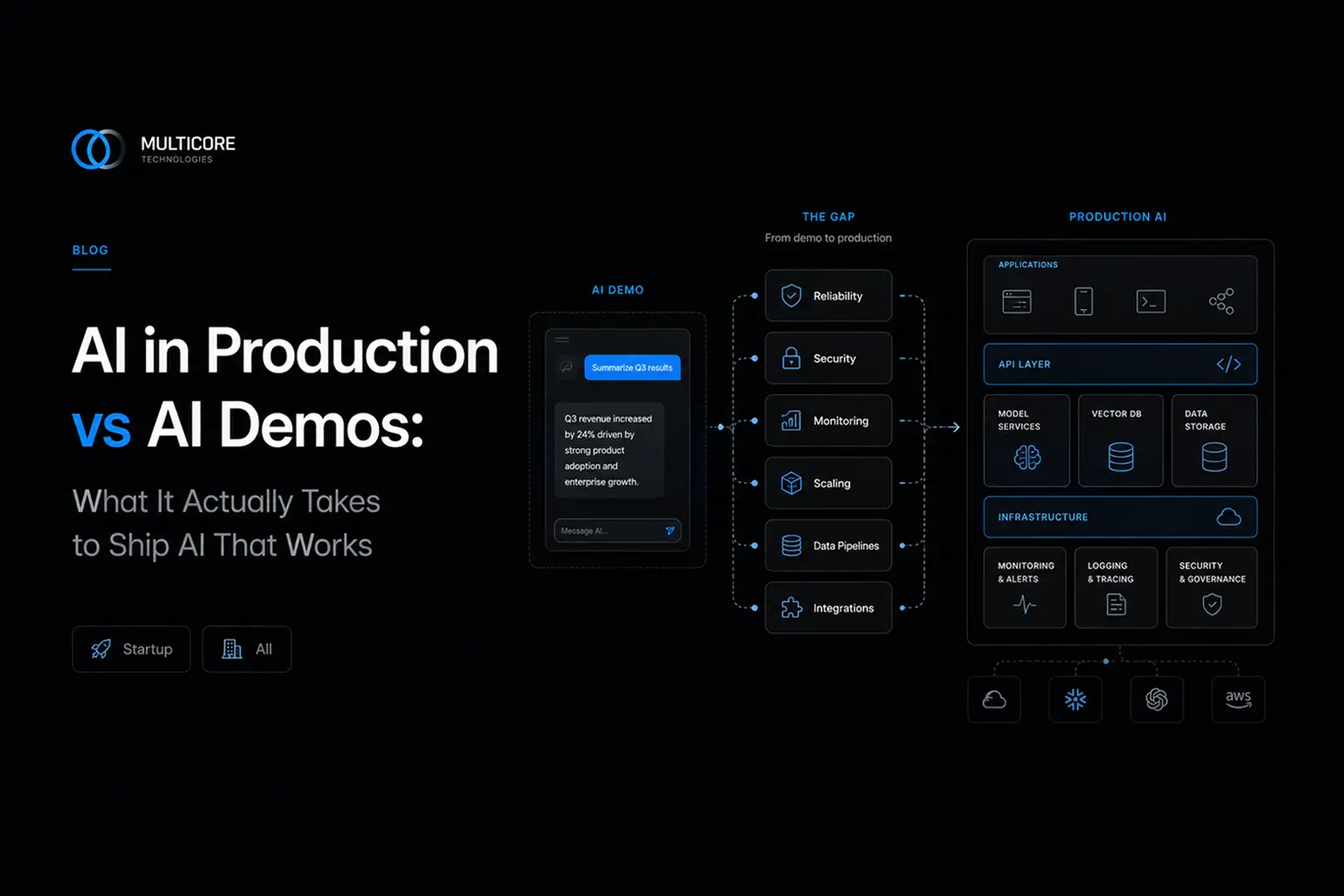
The gap between an AI demo that wows a room and an AI system that holds up under real traffic is wider than most teams expect. A demo proves the model can do something once; production proves it keeps doing it for thousands of users, on data you didn’t curate, inside a budget you can’t exceed.
Why Demos Lie
A demo is a performance. The person running it chose the inputs, knows the questions, and has run the flow a dozen times to find the version that lands. Every prompt is well-formed. Every document is clean. The network is fast, the token budget is irrelevant because there’s one user, and nobody is trying to break it.
None of that survives contact with real users. The moment you open an AI feature to actual traffic, you discover that people paste in malformed text, upload scanned PDFs that are 30% OCR garbage, ask questions in three languages, and occasionally try to make your assistant say something it shouldn’t. The model that looked brilliant on five hand-picked examples now faces a distribution it never saw, and the failure modes that were invisible in the demo become the only thing your users remember.
The uncomfortable truth is that the demo is the easy 10 percent. The model call — the part everyone fixates on — is rarely where projects fail. They fail in the 90 percent around it.
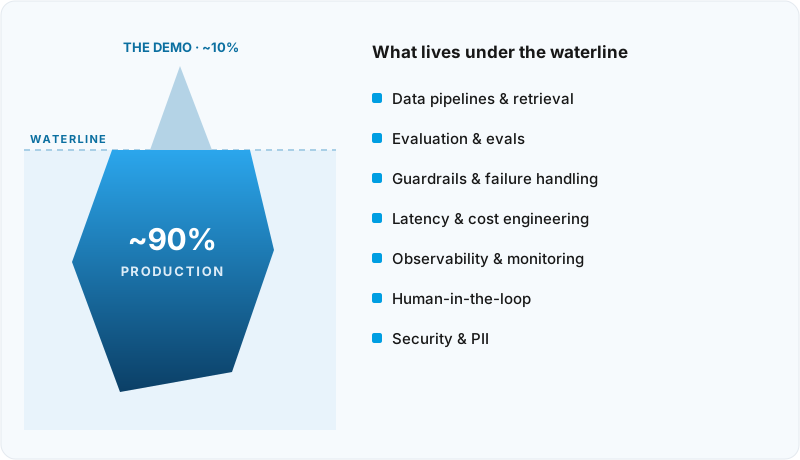
The Hidden 90 Percent
Data Pipelines and Retrieval
Most production AI is only as good as what you feed it. For anything involving your own data — RAG, document Q&A, internal copilots — retrieval quality dominates output quality. That means chunking strategy, embedding choice, index freshness, and handling the long tail of formats real organizations actually store: messy PDFs, scanned contracts, spreadsheets with merged cells, half-broken HTML exports. A demo retrieves from twenty curated documents. Production retrieves from two million, some of them contradictory, some stale, some you legally can’t surface to certain users.
Evaluation and Evals
If you can’t measure quality, you can’t ship responsibly. Demos are evaluated by vibes. Production needs evals — a versioned set of representative inputs with expected behavior, scored automatically so you can tell whether a prompt change, a model upgrade, or a new retrieval setting made things better or quietly worse. Without evals, every change is a gamble, and “it seems better” is the only feedback you have. Build the eval set before you scale, not after the first incident.
Guardrails and Failure Handling
Models fail. They hallucinate, they time out, they return malformed JSON, the provider has an outage. A demo has no failure path because failure isn’t on the script. Production needs to answer: what happens when the model returns nonsense? When it’s confidently wrong? When the API is down for ninety seconds? Real systems validate outputs, constrain them to schemas, fall back gracefully, and refuse rather than guess when confidence is low. The difference between a toy and a tool is what it does when things go sideways.
Latency and Cost Engineering
In a demo, you wait three seconds and nobody minds. In production, three seconds per request at scale is a cost line and a churn driver. Shipping AI means engineering for a latency budget and a cost ceiling: caching repeated queries, routing easy requests to smaller models, streaming responses so perceived latency drops, batching where you can, and knowing the per-request economics before traffic — not after the invoice. An AI feature that works but costs more than it earns is not a feature.
Observability and Monitoring
You cannot operate what you cannot see. Traditional monitoring tells you the service is up; AI monitoring has to tell you whether the answers are still good. That means logging inputs and outputs (within privacy limits), tracking token spend and latency percentiles, watching for drift as real-world inputs shift away from what you tested, and capturing the failures users actually hit. Without it, the first signal that quality degraded is a complaint, and by then it’s been broken for a week.
Human-in-the-Loop
For anything consequential — financial, legal, medical, or irreversible actions — full autonomy is usually the wrong default. Production systems route low-confidence or high-stakes outputs to a human, capture those corrections, and feed them back into evals and prompts. This is not a failure of the AI; it’s the design that lets you ship in regulated or high-cost-of-error domains at all.
Security and PII
Real data carries real obligations. Users will paste personal data, credentials, and confidential material into your prompts whether you intend it or not. Production AI has to handle prompt injection, scrub or tokenize PII, respect data residency, enforce access control so the model never retrieves what a user isn’t allowed to see, and keep an audit trail. A demo ignores all of this. A breach makes it the only thing that matters.
Demo vs Production, Side by Side
| Dimension | Demo | Production |
|---|---|---|
| Inputs | Hand-picked, well-formed, happy path | Messy, multilingual, adversarial, unbounded |
| Data | A handful of clean, curated documents | Millions of records — stale, contradictory, access-controlled |
| Evaluation | Judged by vibes on a few examples | Versioned eval sets, scored automatically on every change |
| Latency & cost | One user, cost ignored, seconds are fine | Latency budget, cost ceiling, per-request economics that must close |
| Failure handling | No failure path — it’s off-script | Output validation, schema constraints, fallbacks, graceful refusal |
| Monitoring | None needed for one run | Drift detection, token/latency tracking, output-quality signals |
| Security / PII | Ignored | Injection defense, PII scrubbing, access control, audit trail |
How to Tell If an AI System Is Production-Ready
When you’re evaluating a vendor or your own team’s work, the marketing demo tells you almost nothing. Ask harder questions. How do you measure quality, and can I see the eval set? What happens when the model fails or the provider has an outage? What’s the per-request cost at our expected volume, and how does it scale? How do you prevent the model from retrieving data a user shouldn’t see? How will we know if quality drifts three months from now?
A team that has shipped real AI answers these crisply, often with a number and a tradeoff attached. A team that has only built demos changes the subject back to model capabilities. Capability is table stakes now — every serious model is capable. The differentiation is entirely in the engineering around it.
A Short Production-Readiness Checklist
- Evals exist and are versioned. A representative input set, scored automatically, run on every prompt or model change.
- Failure paths are defined. You know exactly what happens on hallucination, timeout, malformed output, and provider outage.
- Cost and latency are budgeted. Per-request economics are known and hold at projected scale.
- Retrieval is measured, not assumed. You can quantify retrieval quality, not just trust it.
- Observability is live. Inputs, outputs, spend, and drift are logged and alertable before users complain.
- Human review covers high-stakes paths. Consequential outputs have an escalation route.
- PII and access control are enforced. The model can’t surface what a user isn’t entitled to, and sensitive data is handled deliberately.
If most of these are missing, what you have is a demo with a deployment URL — not a production system.
Shipping AI that survives real users, real data, and real cost is an engineering discipline, not a model-selection exercise. The model is the easy part; everything around it is the work. That’s the work we focus on in our AI engineering work — building systems that hold up after the demo ends. If you’re weighing an AI initiative and want a straight read on what it’ll actually take, start a project with us.